
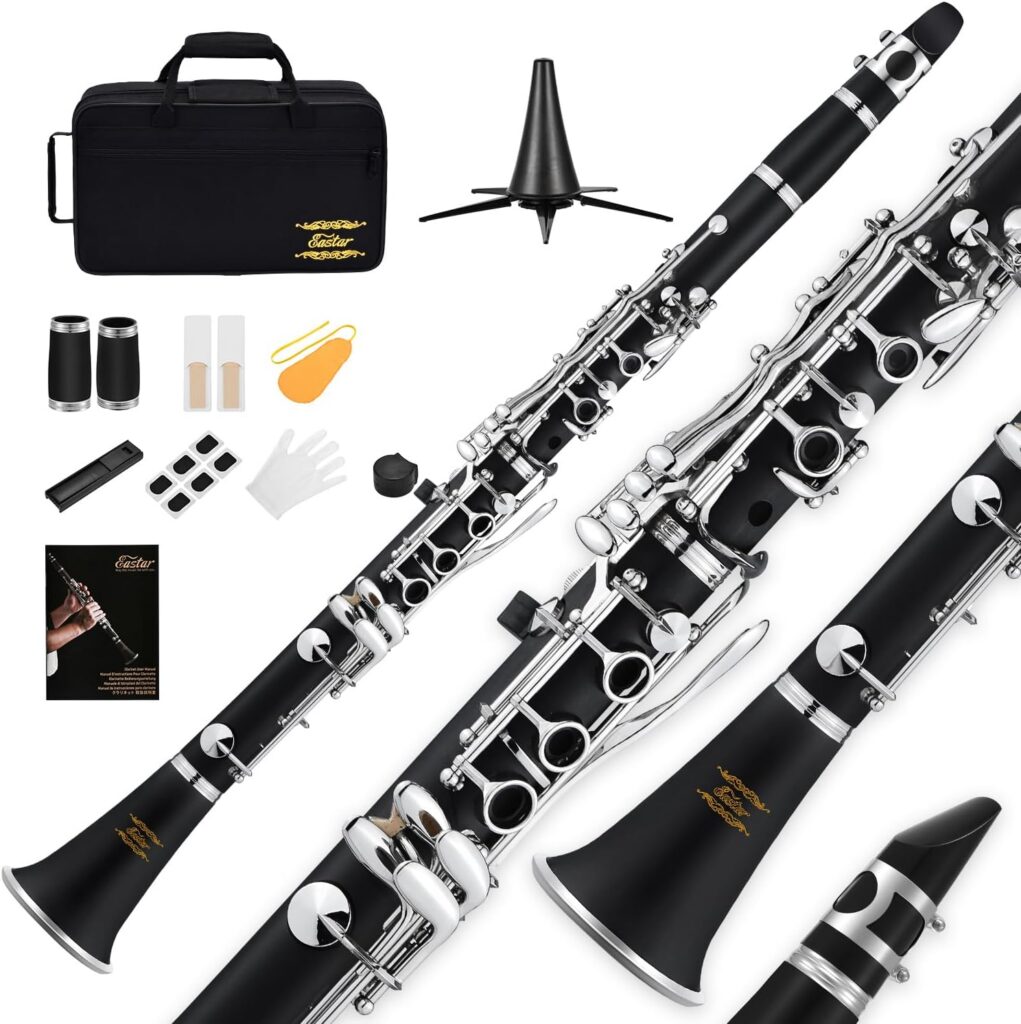
I recently had a Chinese eStar clarinet on my bench that perfectly illustrates the phrase “you get what you pay for.” The instrument was marketed as a beginner clarinet, but what I found made it clear that a student starting on this horn would be fighting the instrument from day one.
When I evaluate a clarinet body, one of the tests I use is a magnehelic‑style leak setup. On my setup, when the system is fully sealed, the gauge drops to 0; when there is leakage, the reading stays up in the leak range. For this test, the upper joint had all of the keys removed. I corked the tone holes so I could isolate the body and pressurize the joint itself rather than test pad seating.
That distinction matters because this was not a case of a bad pad job or a regulation issue. With the keys removed and the tone holes corked, I was testing the body as a sealed structure. A good joint should let the reading drop toward 0 when it is properly isolated. Instead, this upper joint still would not seal the way it should, which told me right away that I was dealing with leakage in the body or tone hole system itself, not anything related to how the keys or pads were adjusted.
To find the leak, I submerged the upper joint in water while it was under pressure. That made the problem obvious. I saw bubbles coming from around the tone hole inserts. The leakage was happening at the interface between the inserts and the clarinet body itself.
That is where the construction of this instrument becomes the real story. Instead of integral tone holes machined directly into the body, this clarinet uses separate tone hole inserts. Inserted tone holes can work when they are made accurately and sealed properly, but on low‑cost instruments they can also become a shortcut that depends heavily on loose tolerances and cheap assembly. On this eStar, the inserts were leaking around their edges, which means the body was not airtight even before any keywork was considered.
For a beginner, this kind of defect is devastating. A student already has to learn embouchure, air support, finger coordination, and intonation. If the clarinet itself has structural leaks in the tone hole system, the student is trying to learn on an instrument that is working against them. That often leads to forced air, biting, unstable notes, and frustration that gets blamed on the player instead of the instrument.
From my perspective as a repair technician, this is the kind of problem that proves the point about ultra‑cheap imports. Yes, the instrument may look like a clarinet and be advertised as suitable for students, but if the body itself leaks around the tone hole inserts with the keys removed and the holes corked off, the instrument has already failed a very basic standard. No beginner has a fair chance on a clarinet built like that.
That is why I keep coming back to the same conclusion: you get what you pay for. A low price may look appealing to a parent or school, but when the body is leaking through poorly fitted tone hole inserts, the money saved up front often buys an instrument that cannot properly support a student’s progress. I would much rather see a beginner on a used, well‑made student clarinet than on a brand‑new bargain instrument that is structurally compromised before the first lesson even starts.
Discover more from Kowal and Son LLC
Subscribe to get the latest posts sent to your email.